


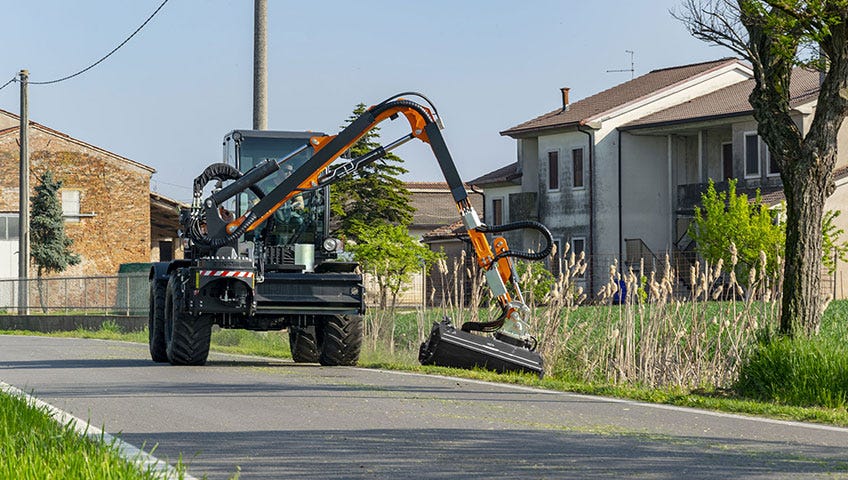
Trent Hills council has agreed to spend $437,322 to purchase an Energreen ILF Kommunal Self-Propelled Hydrostat Machine. (Don’t worry I had no idea what that was either.)
Turns out the machine is basically a small tractor that comes with a flail mower boom that will be used to trim the bushes along our sideroads. This machine replaces a 2007 John Deere tractor and a flail mower that no longer flails.
This purchase illustrates a wider problem that was discussed during the council meeting on Tuesday, the high cost of replacing, repairing and renovating our municipal assets such as roads, bridges, and equipment.
The recently approved 2026 capital budget had included $370,000 for the mower, but the actual cost was $67,322 higher, an 18 per cent jump. That difference will be paid from the fleet reserve fund, essentially the savings put aside in earlier years for such costs.
The challenge is that we don’t have enough revenue to pay for all the capital expenditures we need. This year the gap is about $3 million. We know this because the province has ordered municipalities to track these gaps and find a way to fill them.
Earlier in the meeting, council had a presentation by Peter Simcisko, Managing Partner, at Watson and Associates Economists Ltd. that outlined how the municipality can close that gap.
The easiest and quickest way would be a 16 per cent hike in our property taxes. Easy but not politically palatable.
Simcisko said the annual gap could be eliminated over the next five years by raising taxes about 5.5 per cent each year.
“A typical single-family detached house in the municipality with a current value assessment of $220,000 would see the municipality’s portion of its tax bill rise from approximately $2,115 as of 2026 to approximately $2,761 by 2031,” his report says.
That’s a jump of $646 or 30 per cent.
An earlier study showed that the municipality has $345 million in assets, 40 per cent, or $138 million being our roads. The next largest area is our fleet of vehicles which have a replacement value of $50 million, 14 per cent of total assets.
Most municipalities, provinces and the federal government have a gap between what they should be spending or saving for such costs and what they actually do.
In 2018 the province ordered all municipalities to determine what assets they have and by July 2026 to have a plan for how to pay for them. Simcisko’s report set out the payment options.
He said between 2026 and 2035 the municipality will need to spend $130 million, including $80 million on roads and $17 million on its fleet. In 2026 there is a $3 million gap between the $8.7 million that is needed and the $5.7 million in the capital budget, his report says.
Capital spending will have to rise but there isn’t enough in municipal reserves to cover the cost so the municipality will have to borrow money, Simcisko said. He projected $63 million could come from reserves and $86 million will have to be borrowed over the next decade.
The cost of debt repayments will jump substantially but remain under the provincial borrowing limit. “Annual repayments on external debt (i.e., principal and interest payments) are expected to rise from approximately $1.1 million in 2026 to approximately $7.2 million by 2035,” the Watson report says.
“This is almost disheartening, to say the least,” said Councillor Rick English. “Our shortfall is 16 per cent but we’re not going to ask taxpayers to come up with 16 per cent. This just screams we need help from the upper levels of government.”
Deputy Mayor Mike Metcalf said municipalities need to ask the province for other revenue sources.
In fact, the Association of Municipalities of Ontario has been making that case in recent years.
“It will take investment from all governments to address the need for core infrastructure that underpins our economy,” Robin Jones, the association’s president, said in a news release last August. “Investing in municipal infrastructure now will pay off in long-term productivity.”
An association report says municipalities fund 80 per cent of infrastructure costs as provincial and federal contributions have remained largely unchanged since 2018.
“The need to update the provincial-municipal fiscal relationship has reached a critical point,” the group said recently in its pre-budget submission to the province. “Modernizing this relationship is essential to securing the economic foundations and quality of life our communities depend on.”
One bit of good news. Simcisko said that the funding gap that Trent Hills faces is “towards the lower end of what we have seen with other municipalities.”
“However, you do appear to be facing a period of heavy investment needs over the next 10 years,” he added.
“This report will enable informed decision making,” Metcalf said. “This report gives us an in-depth process to make decisions going forward.”
He pointed out that the province has required municipalities to make these studies and file annual updates, but there is no penalty for not closing the funding gaps, at this point.

You can read all Trent Hills News stories on my website here.
Taxpayers are not a revenue source when already maxed out. What sacrifices are the municipalities making when municipal staff are dedicated to cleaning sidewalks on overtime wages? There use to be by-law enforcement for those whose choose not to maintain a sidewalk. How about contracted services versus high end municipal wages? Where is the innovation from those who are paid to administer and save taxpayers money? Why does council give our taxes away? Why would a donut company in town get a $7,000 grant for renovating a $600,000 building they purchased to make profits. From the Alto train proposal, to jammed packed roads from seasonal visitors, everyone wants to come out to the rural areas, but nobody is stopping in our towns and stores are closing.
What level of government isn't in financial crisis? Passing it all down to the people they're supposed to represent. Carney wasn't joking when he said there would have to be sacrifices. But who's sacrificing what here? Top of the bunch surely aren't feeling it.
Solution after solution: raise taxes. Bled to death by a thousand cuts.
There's a reckoning coming and nobody wants to admit it.