


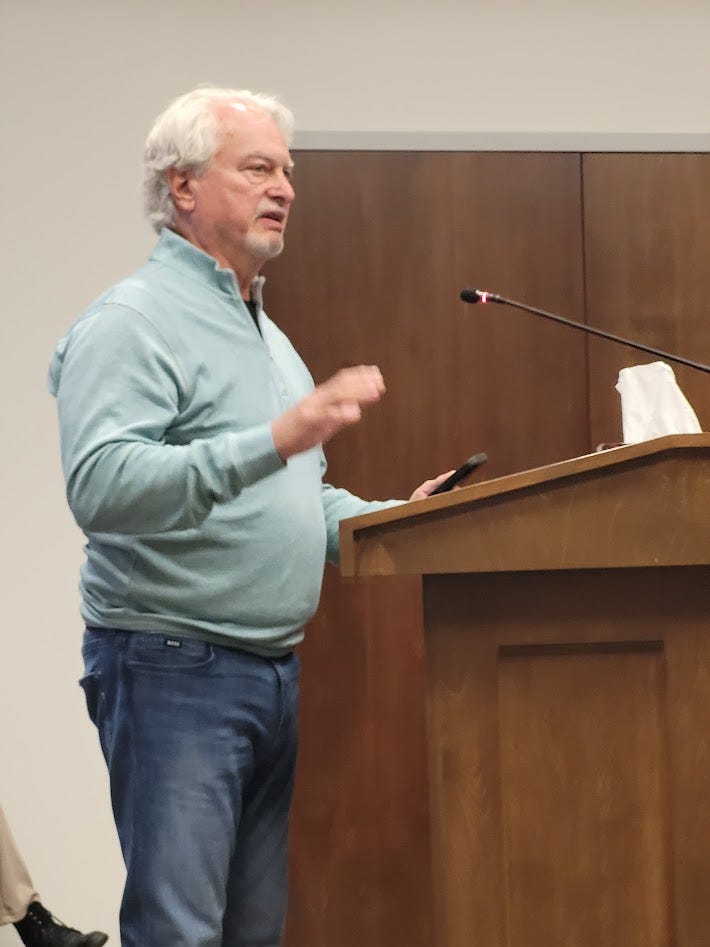
On Tuesday evening about 75 Warkworth residents demonstrated strong bladders, iron butts, and their love for their village.
They swamped the Trent Hills council chambers and hallway outside for a four-hour public meeting so they could tell the councillors and developers that the current plan for 122 Mill Street on the western edge of the village is too dense, and the site is too steep and too wet for so many units.
There was lots of talk about stormwater runoff, increased traffic and other technical issues, but it was clear that the core objection is that the subdivision doesn’t match the artistic sensibilities of the current residents.
“It’s going to change the village of Warkworth into North Oshawa,” said John McLaughlin, who said this proposal would add to units already approved for Orchard Heights and on Banta Road.
“This high-density plan goes against the Trent Hills plan for preserving the village,” said Councillor Rick English, who represents Warkworth. He and others called the site an important gateway into the community.
Resident Victoria Welstead started her comments by asking council why the Warkworth issue was the last of seven items on the agenda, forcing people to sit for more than two hours before it came up. She didn’t really get answer, but Deputy Mayor Mike Metcalf, who was chairing the meeting, thanked everyone for coming and staying.
“We’re all deeply concerned about what this would do to our little village,” Welstead said.
“It will end our pastoral appearance and undermine the character of Warkworth,” said Heather Hill.
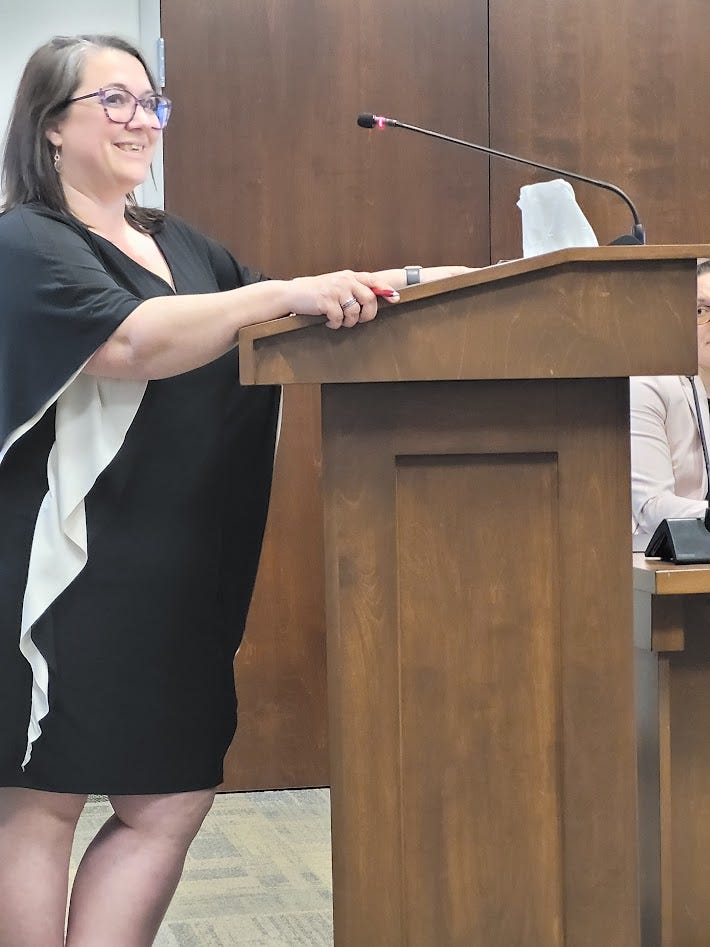
Lawyer Kat Kinch, who often does legal work for the municipality, made clear she was appearing as a resident who lives downhill from the site and only representing herself.
She had submitted a 10-page brief that focused on how stormwater will be handled as it flows down the steep hill and the proposal to include an unopened road allowance as part of the parcel.
Kinch suggested that road allowance should be retained by the municipality, in part because it may be needed to allow access for development on property to the south at some point.
“I think you should pause to consider the stormwater issue and pause to consider the road allowance,” Kinch said.
Dr. Bob Henderson, who owns a home backing onto the parcel, said he too is concerned about runoff since his basement has flooded this spring and there is a large pool of water just across his lot line.
“It is a big hill and the absorption ability of the land will be reduced by the houses and roads,” Henderson said.
Henderson said that he understood that some business owners hope the addition of more residents will provide customers, but he warned that changing the nature of the village will actually hurt businesses.
“We will lose more than we will gain,” he said.
“We are not opposed to housing,” says an online petition with 265 signatures. “We are opposed to the wrong form of housing at one of the most important entrances to our village.”
The meeting was to consider a proposal to sever an existing house and 0.47 acres from the 8.01-acre property and rezone both properties to permit housing. Last year council passed an official plan amendment to shift the property from employment lands to residential, the first step in the development process.
Planner Cameron Law said the property has been identified as a spot for housing since at least 1999.
The draft proposal, which is not an official subdivision plan just a suggestion at this point, would have 11 townhomes in two blocks, 22 semi-detached homes and 10 detached.
Law said the plan would have a density of 10.75 units per hectare, noting that the established neighbourhoods nearby have about eight units. He pointed out that the density is less than suggested under the official plan, which would permit 60 units on the site.
No decision has been made. The comments heard at the meeting will go to council with a staff recommendation.
Under changed provincial law there is no need for another meeting to consider the subdivision plan but Metcalf and English promised that a meeting will be held.
“I certainly support additional housing in Trent Hills, but I do not support the current proposal for 122 Mill Street in its present form,” wrote Jeanne Beker. “If development proceeds, require a lower-density design that matches Warkworth.”
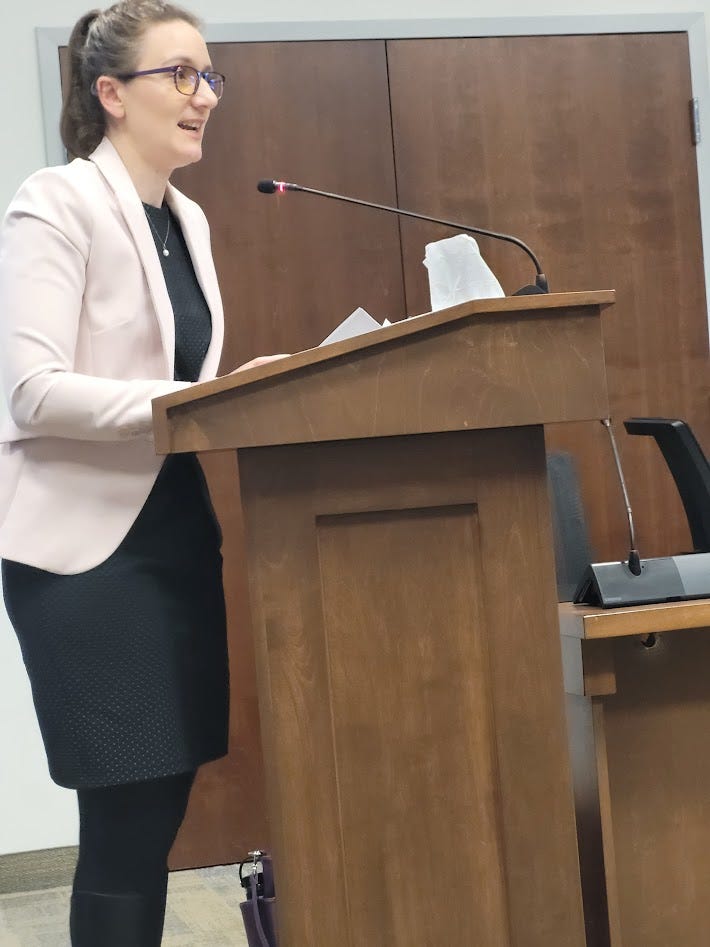
Planning consultant Dafne Gokcen of Innovative Planning Solutions spoke on behalf of the owner Matthew Stearns and developer Jonathan Hartman. Law said that if the proposal is approved it is likely that Stearns will continue to live in the existing property and sell the new lot to Hartman for development.
Gokcen said the developer was ready to have a detailed subdivision plan prepared for the meeting but decided to hold off and respond to the suggestions and concerns.
“Warkworth can grow. It should grow. But growth has to strengthen the village, not overwhelm it,” several residents wrote in letters to council.
A group called the Concerned Citizens of Warkworth filed a 14-page brief outlining concerns about the proposed subdivision. “We are not rejecting growth. We are asking council to distinguish between growth that fits and growth that overwrites.”
The brief says, “Warkworth’s future can be shaped without losing the qualities that made people care about it in the first place and that keep visitors coming back.”
Law told the meeting that recent changes to provincial laws have limited the municipality’s ability to insist on changes to a development’s appearance. It can make suggestions and requests but developers don’t have to listen.
You can watch the entire meeting on YouTube here. Fast forward to the two hour and 15 minute mark to see the discussion of this development.


You can read all Trent Hills News stories on my website here.
I am glad to see residents speaking up. I have been described as a thorn in the municipality side. It has taken over four years to get a solution to our water and road problem on Trent Island. Councillor English will listen and act on your problem. We need more residents to run for council.
It will turn Warkworth into Hastings. There’s the cautionary tale.