


Thousands of homes in Northumberland County that don’t have high-speed internet access won’t be helped by the current $120-million broadband project because the federal government has decided their service is good enough, the county says.
The county is spearheading the broadband project that will serve about 11,000 underserved homes, but it acknowledges that about 1,500 homes, including 300 here in Trent Hills, will not be helped.
Many of those residents have received letters urging them to fill out a survey online if they can, or on paper, by this Friday to help the county mount a campaign to extend the service.
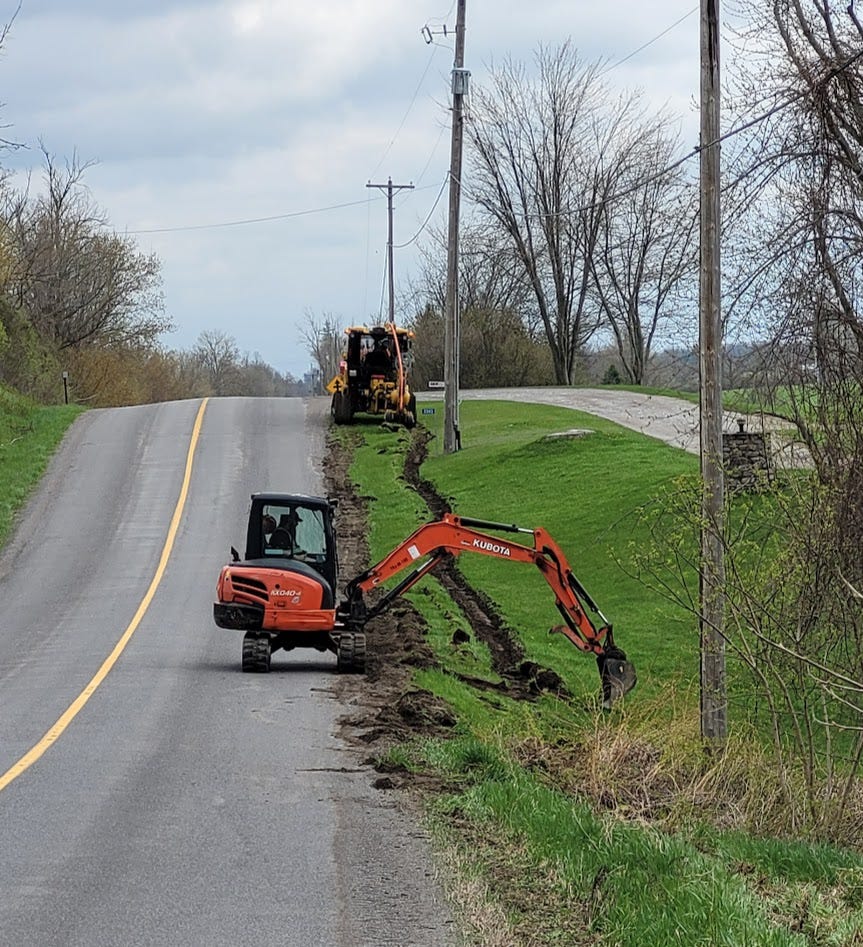
Just two weeks ago, the county issued a news release trumpeting the one million metres of conduit and 600 kilometres of fibre-optic cable that has been installed over the past year. In most areas, the project is now focused on hooking homes up to the cable.
But not everyone is included. Some people in the Warkworth area have discovered that their neighbours can connect for free to the internet service that will be provided by the private company Axle Telecom, but they aren’t included.
The letter from Dwayne Campbell, Director of Economic Development, Planning & Strategic Initiatives, says that in 2021 the county identified 13,000 households that were unserved or underserved by high-speed internet. The project that started in 2025 was designed to serve 11,000 of those homes.
“Since the project was initially designed, about 1,500 of the original 13,000 homes are now considered ineligible to be part of the project,” his letter says. “This is because the federal government has determined these properties have sufficient broadband services. Your property is one of these locations determined to fall outside of current eligibility criteria.”
“This includes 75 out of 300 remaining locations in the Municipality of Trent Hills,” says Communications Director Kate Campbell.
The county’s letter says that while homes may have internet service, it may not be adequate for current needs.
“We understand that even if you do have internet access today, advertised speeds do not always reflect reality for your actual day-to-day household or business experience.”
“The county has since been engaging funders in discussion about a Phase 2 project to cover the remaining 2,000 households and businesses,” Kate Campbell said in an email. “Since the study was originally undertaken in 2021, however, the service landscape has been evolving, and the federal government has recently determined that about 1,500 of these 2,000 locations now have sufficient broadband services.”
The numbers show one thing, we need to show the reality, the county’s letter says. It asks residents to measure and record their actual internet speed so that information can be used to push for more service.
“All of these responses will be used to develop a detailed report to share with provincial and federal funders this fall, to provide a more accurate picture of any connectivity gaps that remain in Northumberland,” Kate Campbell said.
“The county will be sharing this with both elected officials and public servants at both levels of government as part of our ongoing advocacy to make the case for a Phase 2 project – one that includes all of the originally-identified (2,000 remaining) locations,” she said.
“The goal is to ensure rural geography is no longer a barrier to participation in the digital economy,” the county’s news release said. “The county does not consider its work finished until every resident and business can access the high-speed internet they need.”
The federal government contributed $18.4 million and Ontario $45.8 million to the project, the remainder is from the private sector.
This project has consumed $60 million of our money and benefits a number of Citizens as well as not serving the complete County we have given away the rights to the infrastructure - we do not own the fibre. Whomever negotiated this deal should be drawn and quartered!
We pay obscene taxes in Northumberland county and I still have to pay $160 per month for starlink because I can't get anything else. Nothing's changed except that there's been a lot of noise and digging. It's a joke.