


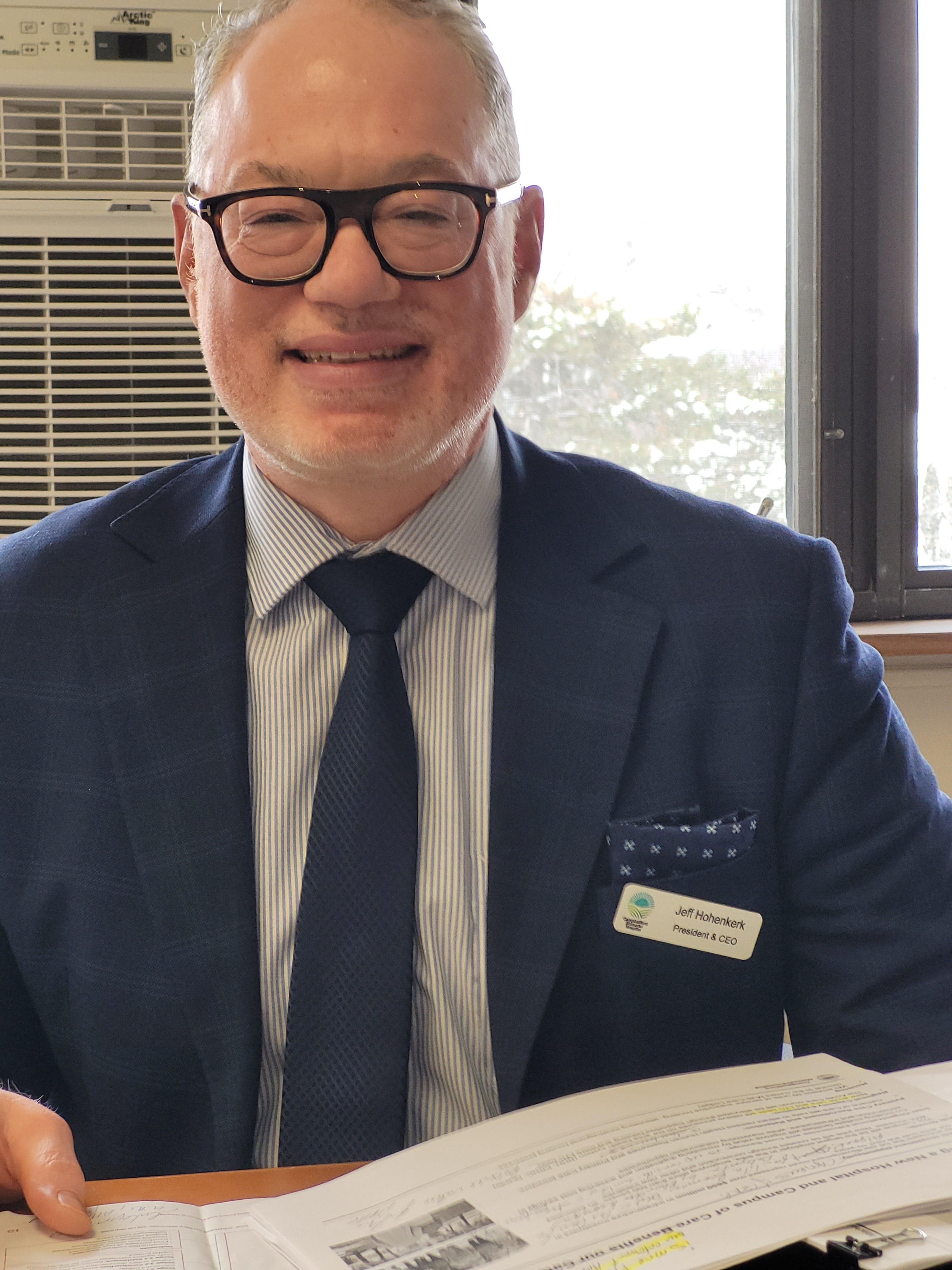
Jeff Hohenkerk is currently working two jobs and hopes that he will continue to for the next eight years.
On the one hand, he’s President and Chief Executive Officer of Campbellford Memorial Hospital and is responsible for the day-to-day operation of the aged, underfunded, busy facility that continues to provide excellent care and roll out new programs and partnerships.
On the other hand, he’s spearheading development of the new hospital he hopes will take shape on the western edge of Campbellford over the next few years as part of a generational project that will increase medical capacity and create hundreds of jobs at what is already the area’s biggest employer.
Last Wednesday I sat down with Hohenkerk in his large office on the second floor of the current hospital to discuss where things stand with the new facility. A 4-by-8 foot design for the Campus of Care leaned against one wall. He pulled out a printed copy of the presentation that he and hospital board chair Carrie Hayward have been making to local councils.
The multi-page document was covered by handwritten notes and important points to cover. From February 3 to April 30 the pair are addressing 10 area municipalities and three counties – Northumberland, Hastings, and Peterborough -- that send patients to our hospital.
Armed with the latest demographic reports, they are driving home that while the hospital may be located in Campbellford it cares for residents in a wide area. That point lays the groundwork to ask those councils to dig deep to pay the huge local share that must be raised in order for the new hospital to be built.
That local share is 10 per cent of the cost of building a new hospital and 100 per cent of the cost of equipment and furniture. For our new hospital this share could top $100 million.
The province wants to know that the community is willing and able to foot the bill.
“Each step will have to show a commitment that we’re working with our local residents and municipalities, and that we can actually raise the money,” he says. “Eventually, it’ll have to be a commitment in writing, and it’ll come from our board. So, we’re not there yet, but they are keeping an eye on this because local share is a big part of this project.”
When Hohenkerk and Hayward addressed Northumberland County council on Feb. 3 they suggested the new building could cost $400 million, leaving us to raise $40 million.
Hohenkerk says that $400 million figure was based on the cost of constructing recently finished similar-sized hospitals such as West Lincoln and Lake of the Woods.
But Hohenkerk says the health ministry has advised him not to use that figure since the actual cost of our facility will likely be much higher by the time it is finished in seven or eight years.
“We’re hoping by fall 2026, we’ll actually have a very close number of what the cost will be to build the hospital,” he adds. As a rule of thumb, the local share including equipment is 20 to 30 per cent of the cost of the building.
We’re not the only community that gags on such costs.
In its 2026 pre-budget submission, the Association of Municipalities of Ontario urged “the province to re-examine the “local share” hospital capital requirement to better reflect the fiscal capacity of municipalities and the contributions to health care services they already provide to a community.”
Premier Doug Ford announced the $2.5 million planning grant last May. So where are we now?
“There are three phases: early planning, detailed planning, and construction and each phase has three stages,” Hohenkerk explains.
We’re currently in the second stage of the early planning phase. The first part was persuading the government that we need a new hospital.
“Right now, we’re in the wish list phase,” he says.
The hospital has hired several consultants to develop a clinical services plan that will look at current and future health care needs, examine population trends, and identify opportunities to strengthen care in the new facility.
“This stage is a detailed business case of the proposals and options and associated costs of what is exactly do you need, what do you want to build,” he says. “Once that gets approved, Then, we go to stage 1.3, which is, okay, now we approve what you want to build. Tell me how many beds, tell me how large, how many floors, how many services.”
Completing the three parts of phase one should take two years. The detailed planning should take one year and construction will take three years.
While the planning is going ahead, behind the scenes work is under way to sever the 48-acre field Jim Curle is donating for the Campus of Care. The land is designated prime agricultural and the official plan does not permit prime parcels to be cut into such small pieces. But at its meeting last week, Trent Hills council supported an official plan amendment that will permit such severances.
It that goes ahead, the land will need to be rezoned to allow institutional use. Meanwhile, planning has to get started to extend the water and wastewater services, and to redevelop County Road 30.
“They’ve been very receptive and we’ve been meeting on a regular basis,” Hohenkerk says of the council. He will make an official presentation at the meeting on March 24.
Once the land is severed and rezoned, Omni Quality Living, which currently operates Burnbrae, has ministry approval for a new 256-bed facility. “They have a design already, they’re just building one in Brighton, so they actually could fast-track a long-term care and complete it within three years,” he says.
Curle is giving his land to the hospital. No decision has been made about how the Campus of Care will accommodate the long-term care home and other facilities. They could sell lots or lease the land. Those are among the hundreds of things to be decided over the next few years.
You can read all Trent Hills News stories on my website here.
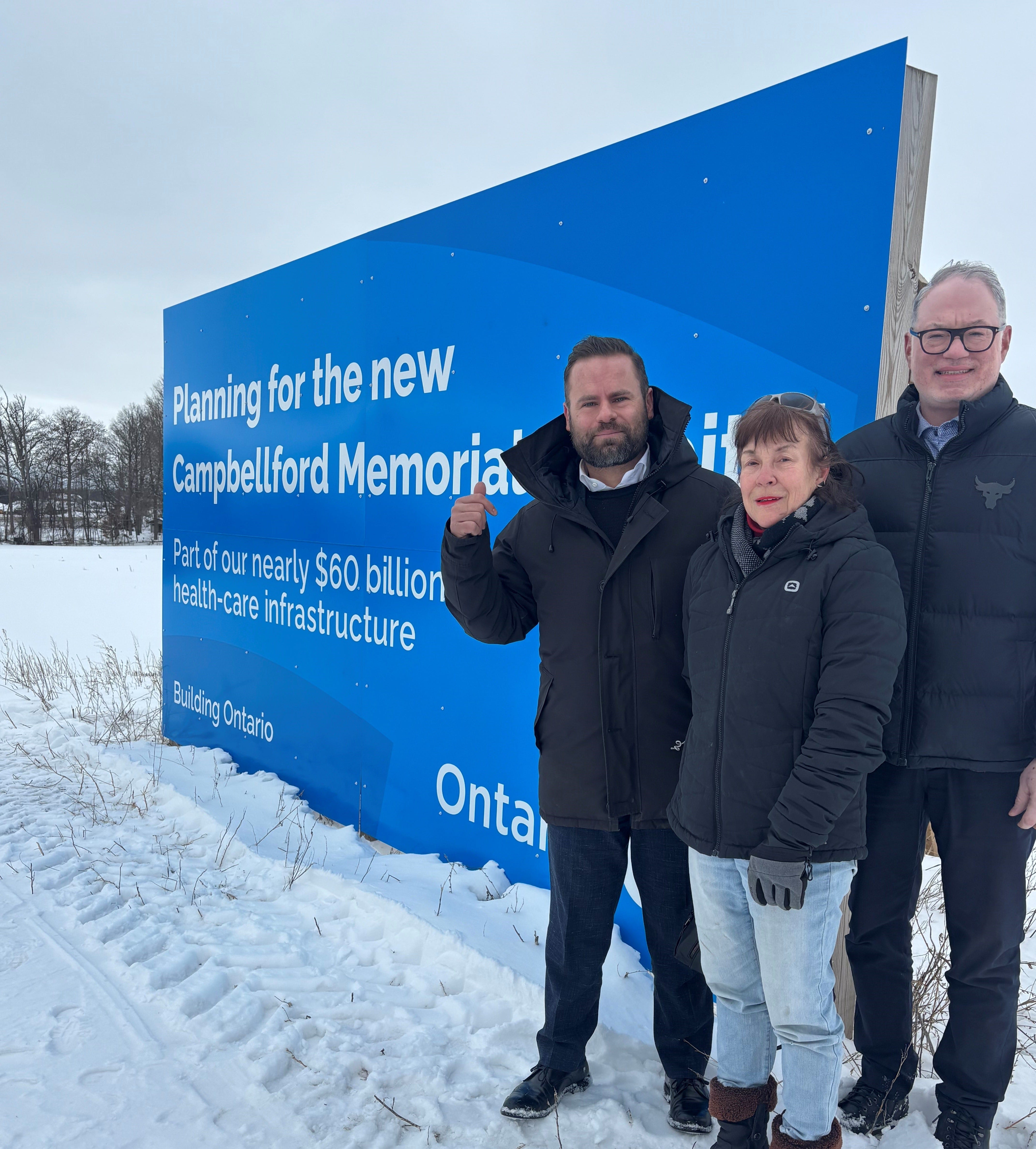
MPP Picinni has his hand up in front of the new sign but I don’t see a cheque in it.