


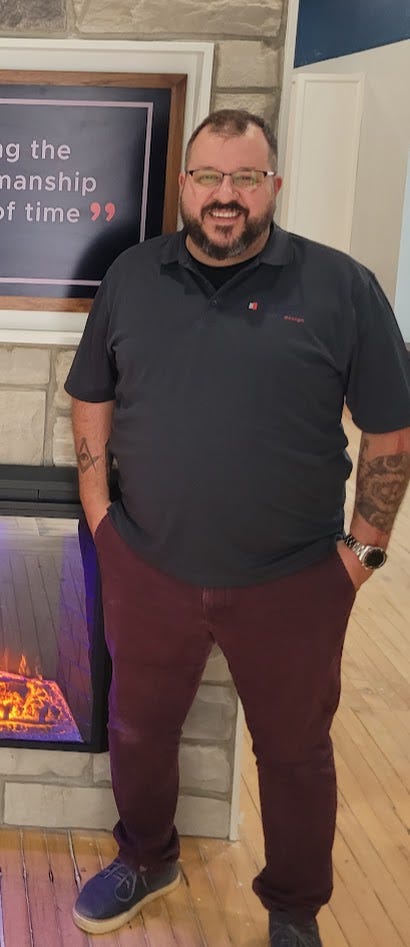
Daniel Giddings wants Trent Hills council to try to persuade Labour Minister David Piccini to force the Workplace Safety and Insurance Board (WSIB) to overturn its decision to kill an 81-year-old program the board says is outmoded, ineffective and wasteful.
You’re probably thinking, ‘Huh, what?’ I’ll try to explain, briefly.
Giddings has proposed a motion that council will consider during its meeting on Thursday, Aug. 20 asking the government and the board, which reports to Piccini, to consider modernizing the Second Injury Enhancement Fund (SIEF) rather than killing it.
He argues in the motion that the board’s move announced last month will raise worker compensation costs for municipalities and other employers. He says the fund encourages “employers to hire and retain workers with disabilities and pre-existing medical conditions.”
“This isn’t about protecting an outdated policy, it’s about protecting Ontario jobs,” Giddings says. “If SIEF is inefficient, then fix it. Don’t eliminate the only cost-relief mechanism that encourages employers to hire workers with pre-existing conditions.”
In an interview, Giddings explained that he’s worried about rising compensation costs as a councillor and as an employer with a construction and renovation business. But he acknowledged that the impetus for his effort to overturn the WSIB change is also driven by the fact his wife Christa works for a consulting company that advises employers how to obtain benefits.
If the motion passes, the municipality would send letters to all Ontario municipalities urging them to tell Piccini and the board to reverse course.
First some context to help you understand this confusing and complex issue.
The Second Injury Enhancement Fund was established in 1945 to help workers injured during the Second World War find jobs on their return by guaranteeing employers they wouldn’t have to pay for medical treatment due to previous injuries.
This program was put in place decades before workers’ compensation plans, human rights protection and medical privacy laws were enacted. It provided some assistance to employers but over the years became extremely complicated and complex.
A review by Deloitte LLP in 2025 said that only 2,400 companies used the program the previous year, less than 1 per cent of the 318,000 employers covered by the board. It was largely used by big companies that had the staff to file the necessary paperwork.
Aaron Lazarus, Vice-President of Communications for the WSIB, said in an interview that the people complaining most about the end of the program are lawyers and consultants who have businesses based on navigating its complex rules.
Eliminating the program will save about 24,000 hours of staff time each year, roughly the equivalent of 15 full-time jobs, Lazarus says. Those people will be reassigned to other jobs. The board has more than 700 employees.
Two things to know about the program. One, It doesn’t actually pay real money to companies. It’s “mirage” money that only exists on paper, Lazarus says.
Second, since a 2020 revamp of how companies are assessed for compensation costs the fund has no bearing on how much a firm pays in insurance premiums, now or in the future.
Lazarus says the board has not done a good job of communicating these changes and how premiums are now calculated.
Studies done in 2008, 2012 and 2014 all recommended the program be eliminated, but nothing was done. Even when the premium system was changed in 2020 no action was taken.
“You could ask why the program wasn’t eliminated sooner,” Lazarus agreed.
So, in 2025 Deloitte was hired to perform a value-for-money audit. It’s 115-page report is a classic example of consultant mumbo jumbo.
It clearly says the program provides no value and doesn’t contribute to either of WSIB’s main objectives – education on workplace safety or helping injured workers get back on the job.
But you can scour the entire report and not find any reference to money, or the cost of the program. I asked Lazarus for the cost, and he explained it doesn’t refer to real money and the actual cost is the staff time required to administer it.
I asked Piccini’s office if he’d like to comment on the issue and they passed me on to the WSIB, which isn’t surprising given all the heat he’s faced for having his office so directly involved in decision making on the skills development training program.
Giddings is not alone on this mission. Some construction groups have urged the government to reconsider the change.
The Council of Ontario Construction Associations, which represents more than 10,000 general and trade contractors, has argued that the fund was critically important to employers and should not be scrapped.
My key takeaway is that the 81-year-old program could be a good PhD topic for someone studying public administration. It illustrates how inertia and special-interest groups can keep programs running decades after they should have been stopped.
We’ll see on Thursday how the councillors see the issue and whether they support the letter-writing initiative.