


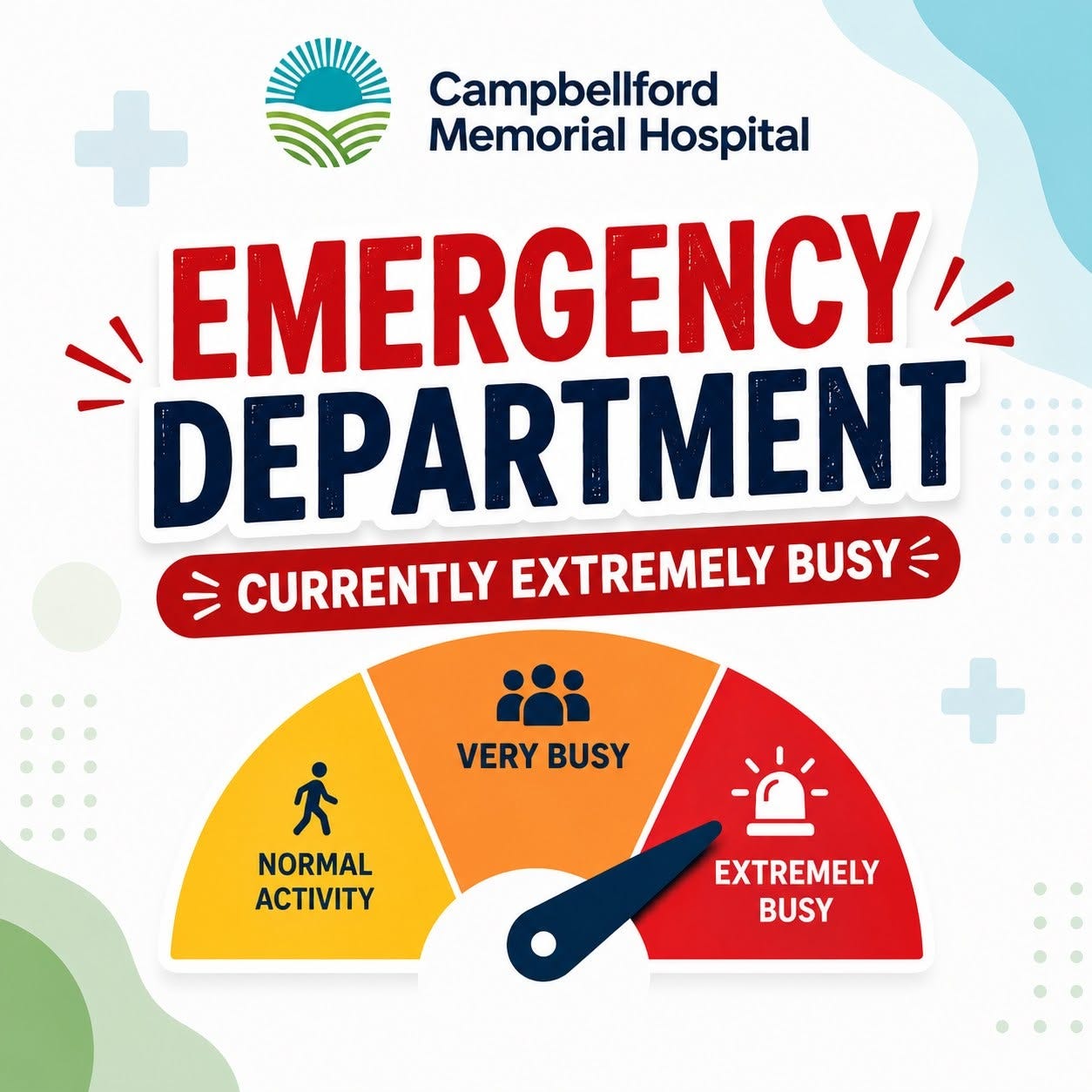
If you’re on Facebook or Instagram, chances are that in recent days you have seen a colourful graphic from Campbellford Memorial Hospital warning that its emergency department is extremely busy.
The post suggests you go elsewhere, if possible.
“Our Emergency Department is currently experiencing higher-than-usual patient volumes. Those with non and less urgent conditions may experience significant wait times.
“If your concern is non-urgent, please review your care options before coming to the ED.”
They offer a list of alternatives here.
These signs and announcements are now routine across the country. In his latest book, The Casino Shift: Stories from an ER on the Edge, Dr. Brian Goldman, author and CBC journalist, shows how the system has gotten much worse over the past 15 years. (You can buy a copy of the book at Spencer Books in Warkworth.)
One thing that’s clear from reading Goldman’s book and talking to managers at Campbellford Memorial, these warnings urging patients to go elsewhere are dealing with wrong end of the problem.
The reason our emergency rooms are so full that care is being provided in waiting rooms and hallways, is not that we have a sudden unexpected jump in emergencies. The problem is that our hospitals don’t have enough beds to care for everyone who needs help.
The biggest challenge is that many people, especially the elderly, are stuck in hospital waiting for a long-term care bed to become available. Some of these folks can be sent home, with extra care, but not all.
With no open beds, it is difficult for patients to be admitted to hospital, so they are kept in the emergency room, here and everywhere else in Canada, it seems. That means there is no room for new patients.
So, expect to see the social media posts more frequently, but don’t accept this situation. We need to push harder to get politicians to build the long-term care beds and other services we require. And to add more hospital beds, Ontario ranks near the bottom of any list of beds per capita.
Annual deficit shrinks, but hospital remains in the red
The hospital recently held its annual meeting and posted its 2025-26 financial results online. While the public focus is largely on all the work being done to get a new hospital built, staff are still working hard every day in an antiquated, under-sized facility that is under-funded by the province.
A recent study of the financial health of Ontario hospitals by the Canadian Centre for Policy Alternatives, found that 61 per cent of small hospitals ran a deficit in 2024-25.
The numbers at Campbellford Memorial for the year ended March 31, 2026, were actually much better than the previous year, but it still wound up in the red. Its budget for the current year projects a fifth consecutive annual deficit.
The hospital reported a loss of $1.1 million in 2024-25, down from $3.4 million the previous year. Legally, hospitals aren’t allowed to run a deficit, but the health ministry can grant special dispensation that waives any penalty.
Total revenue was $38.3 million last year, up from $33.9 million the previous year. The increase came from $4.5 million in increased funding from the health ministry to $34 million from $29.5 million.
On the expense side, costs rose to $38.9 million from $37.1 million. By far the largest expense, no surprise, is salaries and wages. They were $23.2 million, up from $22.7 million.
The second highest category was physician transfer payments and medical staff at $5.7 million, up from $4.9 million.
The notes that are part of the financial statements prepared by KPMG LLP highlight the financial challenges the hospital faces.
“At March 31, 2026, the hospital’s current liabilities exceed its current assets by $2,238,948.
“The hospital has reported financial deficits in each of the last four years, including the current year, with the hospital’s budget for the year ending March 31, 2026 reflecting a forecasted financial loss.
“As a result of these losses, the hospital has incurred a reduction in its working capital and net asset position. Management has identified a number of factors that have contributed to its recurring operating losses, including but not limited to the impact of recent wage settlements, inflationary cost increases and financial pressures resulting from patient volumes and capital commitments.”
The report notes that the hospital has to borrow money each year in order to meet its operating needs.
“As a result of its ongoing financial deficits, the hospital has an increased level of reliance on the Ministry of Health and Ontario Health to assist in meeting its operating and capital requirements at current levels,” it concludes.
The report says the hospital has worked with the ministry to develop a three-year forecast to achieve a balanced budget by March 31, 2028. The projection is based on continued 2 per cent funding increases from the ministry and cost-cutting by the hospital.
You can read all Trent Hills News stories on my website here.